
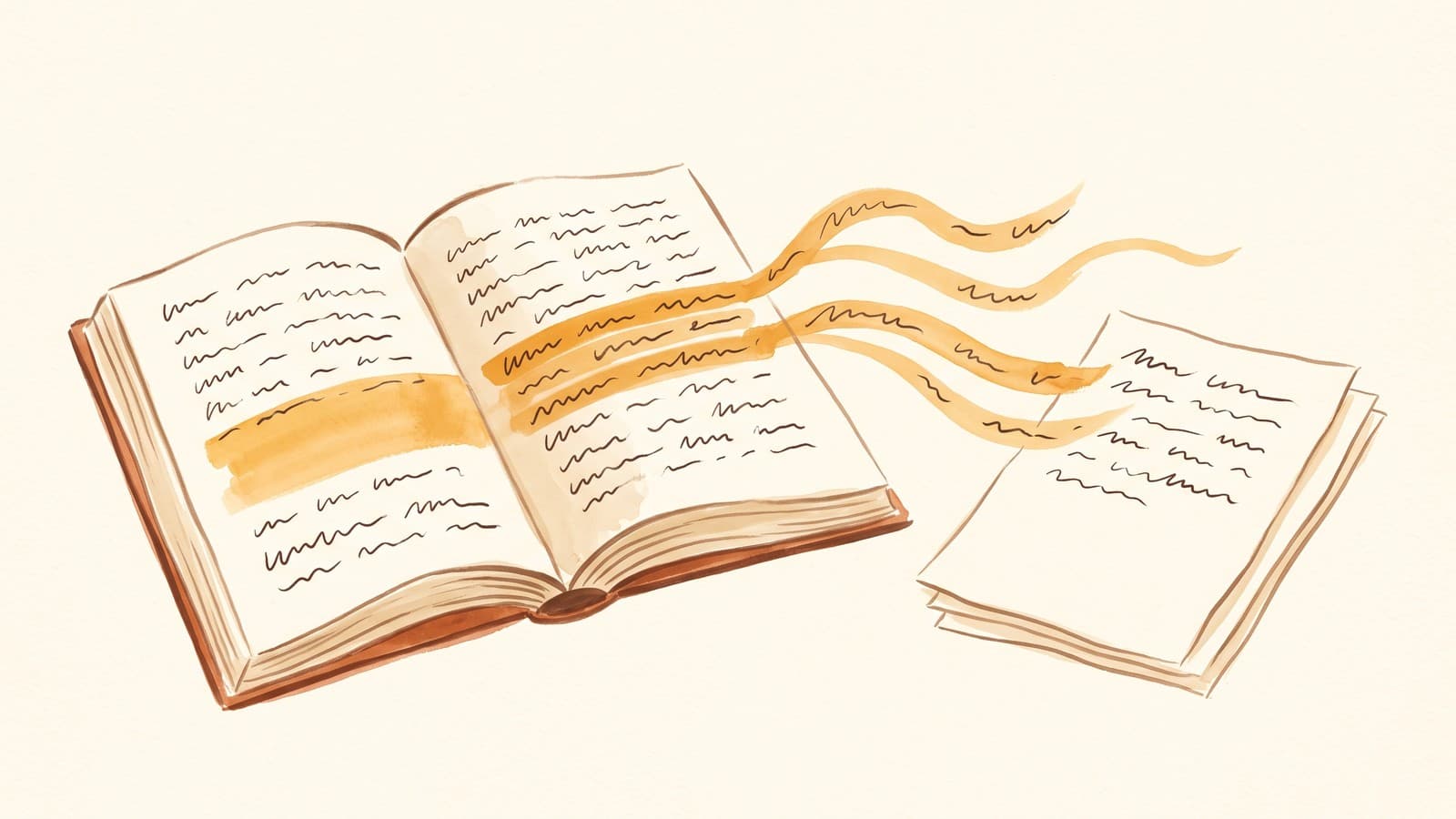
Highlights are not notes
Highlighting is the most satisfying thing you can do to a text and one of the least effective. Both halves of that are worth taking seriously, because the satisfying part is why we all keep doing it and the ineffective part is why the library of highlights never turns into knowledge.
What a highlight actually records
When you drag a finger across a sentence, you are recording one fact: this looked important while I was reading it.
That is a real signal, and it is weaker than it feels. It tells you the passage was salient in context — surrounded by the paragraphs that set it up, in the flow of an argument you were following at the time. It does not tell you what the passage means on its own, why it mattered, what it contradicts, or what you should do differently now that you have read it.
None of that gets recorded, because none of it requires any work at the moment of highlighting. That is exactly the appeal: highlighting is the only form of "engagement" with a text that costs nothing. Learning research has been unkind to it for decades for that reason — it consistently ranks among the weakest study techniques, well below things like self-testing and spaced recall.
The mechanism is easy to see once you look for it. Highlighting is an act of recognition: you see something and mark that you saw it. Remembering requires retrieval: producing the idea later, from an empty page, without the original in front of you. Those are different muscles, and the first one does almost nothing for the second.
The second library problem
So you highlight. The highlights sync somewhere. Now you have two libraries: the articles you did not finish, and the passages you did not revisit.
The second library feels more valuable than the first, and in a sense it is — it is smaller, and every item passed a filter. But it inherits the original problem exactly. A folder of highlights is still a pile of things you will get to. It just took less effort to build, which means it grows faster.
This is why "export your highlights to Obsidian" so rarely ends the story. The export works, the notes land in your vault, and the vault becomes the third place things go to be not-read.
One reasonable response is to stop pretending either library is a queue and treat both as an archive you search rather than a list you clear — which is the bet Cubox makes, and it is a more honest one than most.
What actually works, and who does it
The thing that turns a highlight into knowledge is coming back to it, more than once, spaced out over time, with some effort of recall involved.
Readwise is the most developed implementation of this idea in the read-later category, and it deserves the credit. Highlights sync into it automatically, a daily review resurfaces a handful of them, and the scheduling is genuinely spaced rather than random. If you are already doing that review every day and it is working, you have solved this problem and you do not need another tool for it.
The catch is not the mechanism, it is the format. The review is a screen of text. It needs the same scarce resource the original article needed — quiet, hands, eyes, a clear stretch of attention — and it needs it every day, forever. Plenty of people set up the daily review, get value from it for three weeks, and then watch the email go unopened.
Where audio changes the arithmetic
FeedTalk's bet is narrow and worth stating plainly: the mechanism is right and the format is wrong for most people's days.
The minutes most of us actually have free are spent walking somewhere, waiting, commuting, doing something with our hands. Those minutes are useless for a screen of text and perfectly good for thirty seconds of speech. So the same idea — bring it back, spaced, more than once — gets delivered into the time that exists rather than the time we wish we had.
Two honest caveats:
Listening is not the same as reading. You retain less from a passive listen than from an attentive read. A spoken brief is not a substitute for sitting down with something that matters; it is a substitute for the far more common alternative, which is never opening it again at all.
We do not sync to your notes app. If your highlights need to end up in Obsidian, Notion, Logseq or Roam, FeedTalk does not put them there and Readwise does. That is a real gap and it is on the comparison as one.
If you want to highlight better
Independent of which tool you use:
- Add one sentence at the moment you highlight. Why it matters, or what it contradicts. It costs ten seconds and converts a recognition act into a retrieval cue.
- Highlight less. A page with four marks on it says something. A page that is entirely yellow says only that you read it.
- Schedule the return trip, or accept it will not happen. An unrevisited highlight is a bookmark with extra steps.
- Match the review format to your actual free time. If your spare minutes are spent moving, a daily reading assignment is a plan that will not survive contact with your week.
We keep an honest comparison of how four tools in this category handle all of this — including the rows where FeedTalk is the one that comes up short.